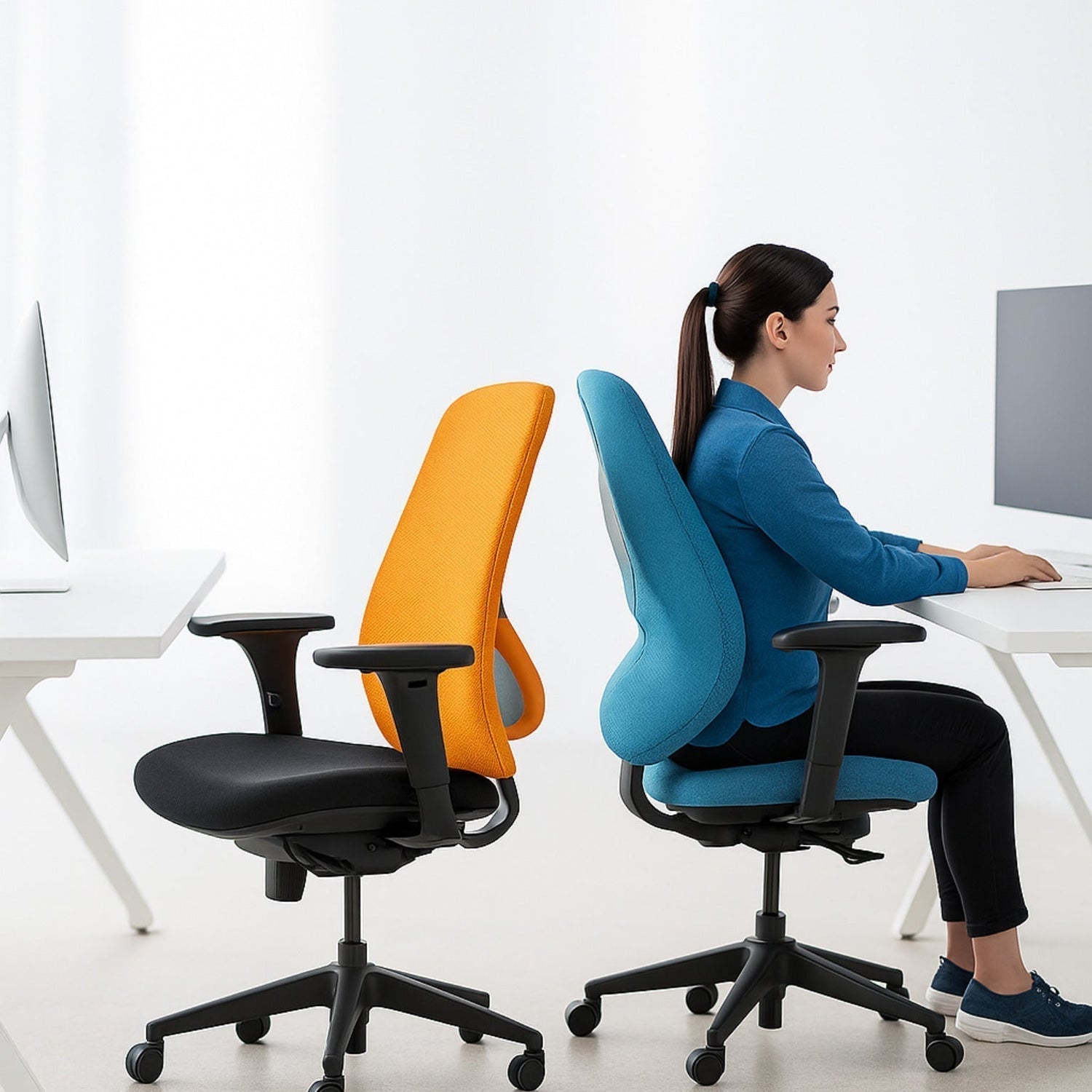
The Office Master YS72 combines a mid-height mesh back with an upholstered seat and a notably adjustable mechanism. Its appeal is straightforward: it offers independent control over the seat and back angles without requiring a tall backrest or a headrest.
This is a guide to the current standard configuration and its fit, rather than a claim that one chair will feel the same to everyone. Arms, upholstery, cylinders, and other selected options can change the final setup.

The standard YS72 at a glance
| Feature | Current standard specification |
|---|---|
| Back | Mid-height mesh, approximately 19 inches wide by 20 inches high |
| Seat | Approximately 20.5 inches wide |
| Seat depth | Approximately 18–21.1 inches with the slider |
| Seat height | Approximately 17–22 inches |
| Back-height travel | 3 inches |
| Mechanism | Standard -7a control with independently locking seat and back angles |
Measurements describe the standard model and are approximate. Selected components and the way the cushion compresses affect real sitting height. The exact configured listing should settle any ordering question.
Independent back-angle adjustment
The back-angle control lets you change the relationship between the backrest and seat. You can position the back for contact during upright work or choose a more open angle for a different task.
“Infinitely locking” describes positioning within the mechanism's available range, rather than a few fixed stops. It does not mean unlimited travel. The aim is useful support, not forcing the back against your body as firmly as possible.
Independent seat-angle adjustment
The separate seat control changes the angle of the seat surface. This is a different adjustment from back tilt; the original version of this article used the same heading for both.
Because the controls are independent, changing the seat angle does not require choosing one fixed seat-to-back relationship. That flexibility may appeal to someone who likes fine adjustments. A person who prefers a simpler, coordinated recline may find a synchronous model more intuitive.
Seat angle is also different from seat height. The cylinder raises or lowers the chair; the mechanism controls its angular position.
A seat slider that changes the fit
The YS72's depth range allows the seat to move relative to the backrest. That helps accommodate different thigh lengths while keeping back support accessible.
The practical goal is enough thigh support without pressure at the back of the knees. If the seat is too deep even at its shortest setting, sitting on the front edge defeats the reason for having a backrest. A shorter-depth model is the more useful comparison in that case.
Back height and the mesh feel
The back-height adjustment moves the mesh back through about three inches of travel. This helps position its shape against the torso. It does not add an adjustable headrest or change the size of the seat.
Mesh has a different feel from an upholstered back and leaves space for air movement through the backrest. That can be appealing in a warm workspace, although comfort also depends on clothing, room temperature, and your preference for cushioning.
Who is the YS72 likely to suit?
The YS72 is worth considering when its 20.5-inch seat width and depth range fit, you like a mesh back, and you want separate seat and back controls. Its mid-back label does not make it a petite chair. Minimum seat height and depth are better indicators for a smaller user.
For a lower and shorter seat, the PT62 is a useful alternative to compare. For a taller mesh back with a synchronous mechanism, the YS78 takes a different approach. The YS79 adds a headrest, but that feature still needs to land comfortably for the user.
What to expect from the controls
A multi-control chair rewards a little familiarity. The lever positions and operation should be taken from the adjustment instructions for the actual mechanism on your chair. Generic advice about pulling every lever out or turning every knob in one direction can be misleading.
Once set up, the useful question is whether you can sit against the back, keep your feet supported, and reach the work without being pulled forward. Changing the chair and desk together often makes more sense than repeatedly adjusting one control.
A focused choice within the Yes series
The YS72's strength is its combination of a mesh mid back, depth adjustment, back-height adjustment, and independent angles. It is a sensible shortlist candidate when those features address your needs. Someone seeking a deeper oversized seat, a high back, or automatic recline resistance has a different comparison to make.
See the current YS72 product page for available options and the final configured price.