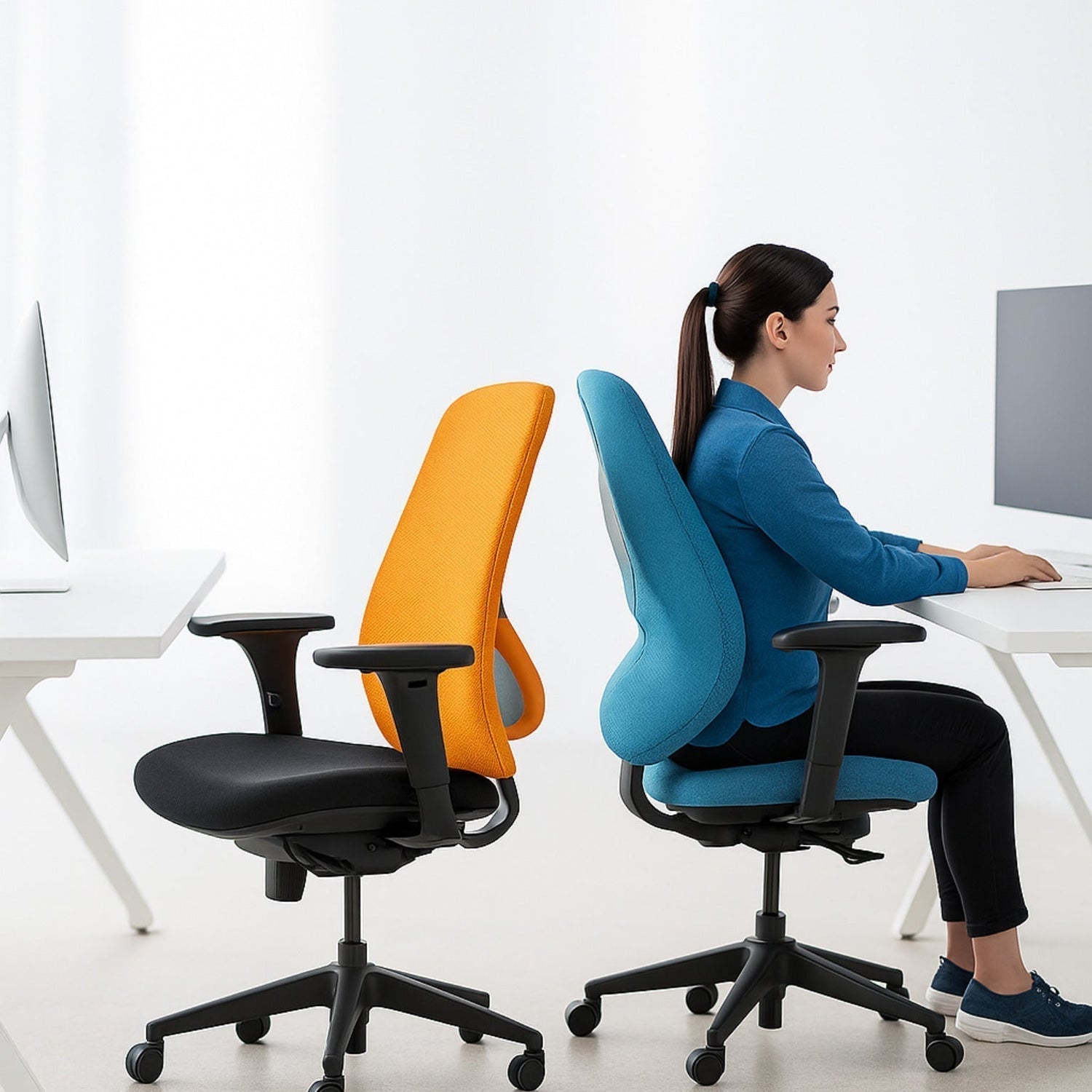
Office Master chairs use several different mechanisms. Some let you position the seat and back independently. Others link the two in a synchronous recline, and the OM5 Evolved family uses body-weight-responsive movement. Knowing which control you have makes adjustment much easier.
This guide explains the common functions and a useful order for establishing fit. Lever locations, release sequences, and knob directions vary, so the instructions for your exact model and mechanism remain the reference for operating them.
Start with the chair you actually own
The model label and order configuration are useful when identifying controls. Two chairs with the same model name may have different arms, cylinders, or alternate mechanisms. A photograph of the underside and control levers can help OMC identify the relevant instructions.
The manufacturer provides information through its assembly and care resources and individual series pages. If a lever is stuck, a component is loose, or the chair behaves unexpectedly, stop using it until the problem is assessed.
A sensible adjustment order
- Establish a seat height that works with the desk and supports the feet.
- Set seat depth so you can use the backrest without the seat pressing behind the knees.
- Position the backrest and any lumbar support for comfortable contact.
- Set the arms so they support the forearms without lifting the shoulders or blocking desk access.
- Adjust recline, resistance, and available angle controls to suit the task.
Changing one setting may affect another. It is normal to revisit the height after positioning the arms or moving the keyboard.
Seat height: the pneumatic lift

The gas cylinder raises or lowers the seat. On many task chairs, operating the height lever while seated lowers the chair, while removing your weight allows it to rise. The actual lever should be identified from the model's instructions.
The cylinder controls height, not seat tilt or recline. If the chair cannot reach a suitable height, the answer may be a compatible alternate cylinder or a change in desk setup rather than forcing the control past its range.
A high desk may require a higher sitting position and a stable footrest. A lower chair alone is not enough if it leaves the keyboard above a comfortable working level.
Seat depth: the sliding seat

A seat slider moves the seat relative to the backrest. Moving it forward makes more seat available beneath the thighs; moving it back shortens the depth.
The useful position supports the thighs while leaving clearance behind the knees. If the shortest setting is still too deep, the chair may be the wrong size. Leaning away from the backrest is not an effective substitute for a shorter seat.
Back-height adjustment

Moving the backrest changes where its contour meets the torso. This can be especially helpful when placing the lower-back support. It does not change the chair's working height.
Some OM models use a ratchet-style back-height system, while others have a different release. The reset sequence depends on the mechanism. Follow the specific instructions instead of assuming every backrest releases at the top of its travel.
Independent back and seat angles

A tilting back control changes the backrest angle. A separate seat-tilt control changes the angle of the seat surface. Chairs such as the standard YS72 allow these positions to be set independently within the available range.
“Infinitely locking” means the control can lock at positions throughout that range, rather than only at a few detents. It does not describe unlimited movement. A comfortable setting allows support without making you slide, brace, or reach awkwardly.
Rocking motion and tension

A rocking or free-recline mode allows the mechanism to move as you shift your weight. A tension control changes the resistance to that movement.
The correct setting lets you recline with manageable effort and return smoothly. The knob's direction and the number of turns vary by control, so universal clockwise or counter-clockwise advice is unreliable. Adjust within the manufacturer's range and test the movement gradually.
Support your back when releasing a tilt lock, and anticipate that the chair may move. A lock and a tension adjustment do different jobs.
Adjustable lumbar support

An adjustable lumbar feature changes the prominence or position of the lower-back support, depending on the chair. Back-height adjustment may move that support vertically, while a separate knob or slider changes another aspect of its shape.
Comfortable contact is the goal. Increasing the protrusion as far as possible can make the support feel intrusive. The mechanism and operating direction should be confirmed for the model.
Synchronous tilt

A synchronous mechanism coordinates seat and back movement. The back commonly travels through a different angle from the seat, giving the recline a different feel from independently positioned controls.
Models vary in their resistance adjustment, locking positions, and release operation. The YS78, for example, uses a synchronous mechanism, while the YS72's standard control takes the independent-angle approach.
Body Activated Motion on the OM5 Evolved family
The current OM5 Evolved family uses Body Activated Motion, often shortened to BAM. Its self-weighing recline responds to the user's movement with less manual tension setting than a conventional mechanism.
The chair still needs to fit. Seat depth, lumbar positioning, arms, and working height remain useful adjustments. Its Virtual Pause feature is distinct from a conventional mechanical tilt lock; it should not be described as a lever that fixes every reclined position.
The OM5 Active Tasker is a separate design. Sharing the OM5 name does not mean it carries the Evolved family's entire feature set.
Arms, headrests, and the surrounding desk
Arm height and spacing affect forearm support and access to the keyboard. A headrest is useful only when its position feels comfortable, particularly as you recline. Neither should push you away from a good working position.
After adjusting the chair, bring the keyboard and mouse into easy reach and place the monitor for the task. The chair's controls work best as part of the whole setup.
When an adjustment does not solve the problem
A cylinder that sinks, an angle that will not hold, or a damaged component may need service rather than a different setting. OMC can help identify the model and suitable replacement part from the label, order details, and photographs.
Once the chair feels supportive, allow changes of position through the day. A good setup gives you comfortable choices, rather than one posture to keep indefinitely.