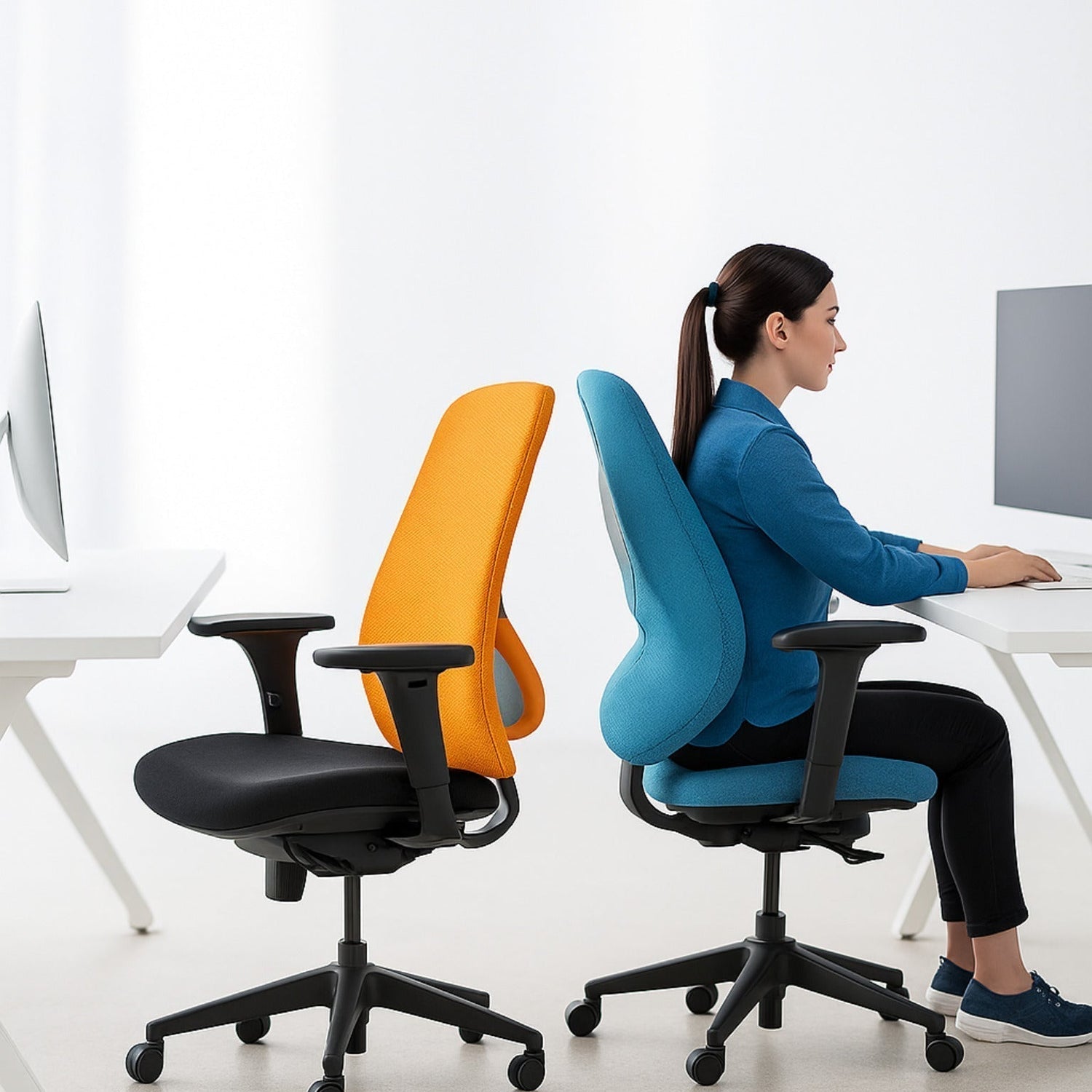
Being over 6’1” narrows the chair search, but height alone does not tell you which seat will fit. Two people of the same height can have different thigh lengths, torso proportions, and preferred working positions. The useful comparison is between your measurements and the chair’s seat depth, height range, backrest, and arm spacing.
The five OM Seating models below give taller users different ways to approach that fit. Some offer an extra-tall back; others put more space in the seat. A larger chair is helpful only when its extra room is in the right places.
What matters most for a taller user?
A seat that ends too far behind the knees can leave much of the thigh unsupported. A deeper seat can help, provided you can still sit against the backrest with a small gap behind the knees. A seat slider makes this easier to judge than an overall chair-depth measurement.
Seat height is a separate question. Your feet need stable support, and your work surface should allow relaxed shoulders and easy access to the keyboard. A taller cylinder may suit longer lower legs, but raising the chair also changes your relationship to the desk. Back height, meanwhile, is a matter of where you want support: a tall person can be comfortable with a mid-back design if the lower-back support and seat fit work well.
- Seat depth: enough thigh support while you remain in contact with the backrest.
- Seat height: a range that works with both your legs and the workstation.
- Seat and arm width: room to move without reaching sideways to use the armrests.
- Backrest and headrest: the support you prefer, with the exact headrest configuration confirmed before ordering.
- Weight and use rating: appropriate for the user and the hours the chair will be occupied.
Five chairs to compare
PT79: extra-tall upholstered back

The PT79 is the tall-back option in the Paramount family. The current standard configuration pairs a 19.5-inch-wide, 28-inch-high backrest with a 21-inch-wide seat whose depth adjusts from 18 to 21.1 inches. Its standard seat-height range is 17–22 inches.
Those dimensions make it a useful starting point for a taller user who wants an upholstered back and separate control over seat and back positioning. The standard full multi-function mechanism offers seat tilt, back angle, rocking tension, and forward tilt; other mechanism choices change the adjustment experience. The PT79 is rated for 300 pounds, so taller users who also need a higher weight rating should compare the heavy-duty options separately.
PTYM: a deeper, wider seat

The PTYM’s main distinction is its oversized seat: 23.5 inches wide, with a standard depth range of 20.5–23.6 inches. Its standard seat height is 19–25 inches. It has a lower backrest than the PT79, so it suits a different preference even though both can be relevant to tall users.
This is worth comparing when a conventional seat slider still feels too short. The same dimensions can be excessive for someone with a narrow build or a shorter thigh length. A tall chair is not automatically a wide chair requirement. The PTYM is rated for 300 pounds; its width should not be mistaken for a higher weight capacity.
YSYM: mesh back with an oversized seat

The YSYM combines a high mesh back with an oversized seat, a longer seat-depth range, and a higher standard seat-height range. It gives tall users an alternative to the upholstered PTYM while retaining a full multi-function control.
The standard manufacturer listing describes a high-back chair, not a headrest-equipped base model. Headrest availability and the exact selected configuration need to be checked rather than assumed from a photograph or an older listing. Like the PTYM, the YSYM is a roomy choice that deserves a measurement check before ordering, especially if your height comes mostly from your torso.
PAC59-7a: an upholstered high-back task chair

The PAC59-7a, formerly PA59, offers a tall upholstered back, a seat slider, and back-height adjustment in the PAC task-chair range. It is an alternative for users who want a conventional office-chair shape and do not need the oversized seating area of the PTYM or YSYM.
Its fit still depends on the actual seat-depth and cylinder choices in the configured chair. The PAC range includes different control mechanisms; the “7a” designation is meaningful, so a feature described for a PAC59-8b should not be assumed to apply to this model.
MX88IU: a wider platform and higher weight rating

The MX88IU is the large and extra-tall Maxwell configuration. Its 25-inch-high back and 24-inch-wide seat are worth comparing when you need a larger platform as well as a higher load rating. The manufacturer’s 2026 pricebook lists the standard configuration at 450 pounds.
The 7878MX previously featured here is marked as phasing out in that pricebook. Confirm its availability before ordering; the MX88IU has different back dimensions, so it should be compared by fit rather than treated as an identical replacement.
For shared, long-shift workstations, the use rating and chosen components matter alongside the dimensions. Arms, casters, and cylinders should be selected for the intended user and floor. Someone who is tall but slim may find a less oversized model easier to fit.
How to narrow the choice
The PT79 puts the emphasis on back height; the PTYM and YSYM put more space into the seat. The PAC59-7a is a more conventional high-back task option, while the MX88IU adds a higher weight rating. That is a more useful distinction than treating the five as a universal best-to-worst ranking.
Measurements from your current chair can also help. If its seat is too short, note how much additional depth would allow you to sit against the backrest comfortably. If it fits well but the back feels low, a taller back may be the only major change you need. Arm spacing and clearance under the desk are easy to overlook in either case.
Questions taller chair shoppers often ask
Does everyone over 6’1” need a headrest?
No. A headrest is a preference and fit feature, especially during recline. It needs to reach the right area without pushing the head forward. A well-fitting seat and backrest matter whether or not a headrest is included.
Is the widest chair the best choice?
Only when that width is useful to you. Extra space can make armrests harder to reach and may come with a seat that is too deep. Tall and broad builds often benefit from different configurations than tall and narrow builds.
Can a taller cylinder fix an otherwise small chair?
It changes seat height, not seat depth, back size, or arm spacing. It can solve a height-range problem on a chair that otherwise fits, but it cannot turn a shallow seat into a deeper one.
For help comparing measurements or configuring chairs for a team, contact OfficeMasterChairs.com. We can work from the fit problem you are trying to solve rather than height alone.