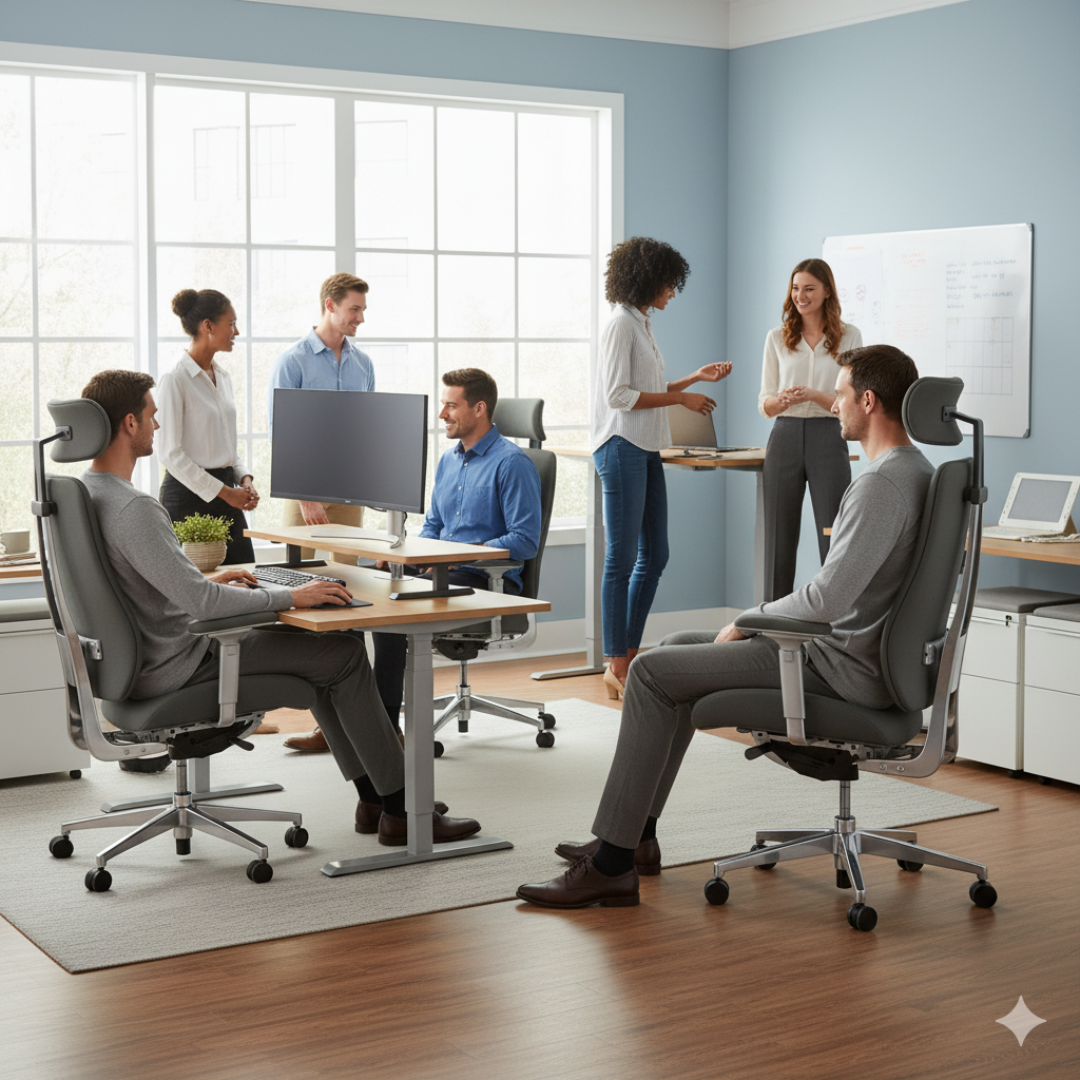
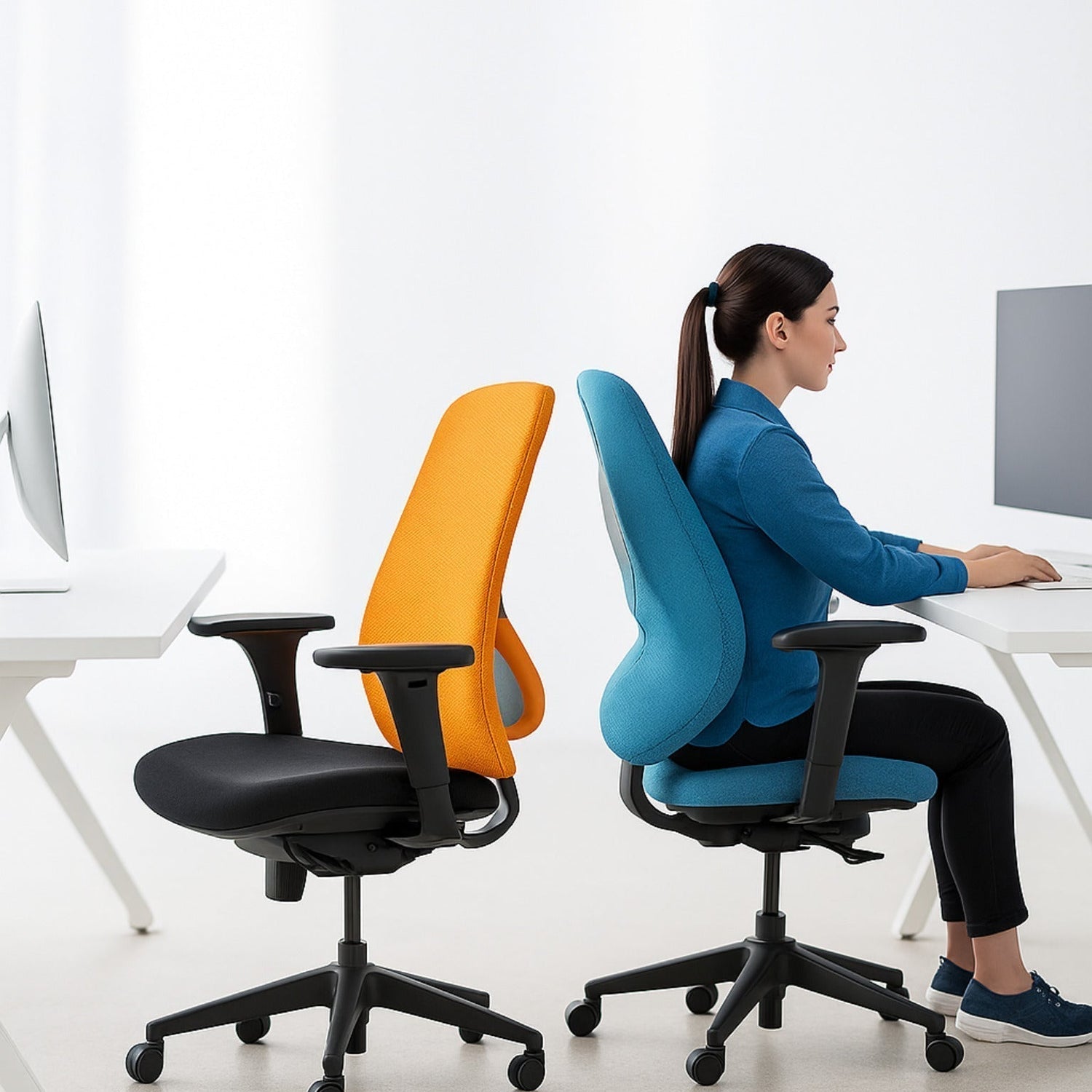
For a shorter user, the most useful chair specification is often its minimum seat height or depth. A chair can have plenty of adjustments and still remain too high or too deep at its smallest setting.
The goal is a seat that lets you use the backrest, support the feet, and reach the desk comfortably. That depends on your proportions and the work surface, rather than a universal height cutoff.
Seat height and seat depth solve different problems
Shorter lower legs can call for a lower sitting height. Shorter thighs can call for less depth between the front edge and backrest. It is helpful to identify which limitation matters most in your current chair.
If the seat is too deep, sitting forward may free the knees but leave the back unsupported. If the seat is too high, lowering it may help the feet but make a fixed-height keyboard harder to reach. The chair and desk need to work together.
Five current OMC comparisons
These examples offer different combinations of size and adjustment. They are candidates to compare, rather than a ranking that promises every shorter user the same fit.
1. PT62: a lower standard height range

The standard PT62 combines a seat-height range of approximately 15.5–19.5 inches with an approximate 16–19.1-inch depth range. Its 19-inch-wide seat, back-height adjustment, and full multi-function control make it a useful smaller task-chair starting point.
The lower cylinder is a meaningful distinction from several other PT models. It still needs to place you at a suitable height for the work surface.
2. PT69: shorter depth with a taller back

The PT69 has an approximate 15.5–18.6-inch seat-depth range and a taller upholstered back with lumbar adjustment. Its standard seat-height range is approximately 17–22 inches.
This can be a useful depth comparison for someone who likes a taller back. It is not as low as the standard PT62. Treating it as automatically perfect for all short users would overlook that difference.
3. PAC63: the current PA63 counterpart

The PAC63 is a small-to-medium task-chair option with several adjustments. The current name replaces PA63 in older articles and links. Its configured seat dimensions and cylinder are the figures to compare with your needs.
“Small-to-medium” describes the intended comparison; it does not guarantee that its lowest height suits every shorter user.
4. CL44EZ: a simpler small task chair

The CL44EZ offers independent height, back-angle, back-height, and seat-angle controls in a smaller task-chair design. It is worth comparing if those functions meet your preferences without the extra controls of a full multi-function model.
Its current starting price is above $300, so older budget references should not be used to estimate the final cost. Available options can change that total further.
5. DB53: an alternative back shape

The DB53 combines a pear-shaped upholstered back with a seat slider, back-height adjustment, and independent seat and back positioning. It offers a different support feel from the PT and PAC examples.
The chair belongs on the comparison only when its minimum seat dimensions work for you. A comfortable back shape cannot compensate for a seat that remains too deep.
Arm spacing can be easy to overlook
Low armrests help only if they can also sit close enough to support the forearms. Widely spaced arms may encourage reaching sideways even when the seat height is suitable.
Pad position and desk clearance matter as well. The arms should not force you to stop short of the keyboard or hold the shoulders raised. The selected arm model can change that experience substantially.
A footrest can solve one mismatch
At a high fixed desk, a slightly higher sitting position may be necessary to reach the work comfortably. A stable footrest can then provide support for the feet.
It cannot shorten the seat or move a poorly positioned back contour. Those problems need a different adjustment range or chair size. A stack of unstable objects is also a poor substitute for a suitable foot support.
The backrest does not have to be short
A shorter user may prefer either a mid back or a taller back. What matters is where the contour and upper edge contact the body. A headrest that pushes the head forward can be uncomfortable even on a chair with an otherwise useful seat.
Back-height adjustment helps position support, but the available range has limits. A trial sit is useful when contact feel is difficult to predict from dimensions alone.
Making the comparison more personal
A useful shortlist includes the minimum height and depth you need, the arm spacing that feels comfortable, and the desk height you work at. Prices and available configurations are shown on the current product pages.
OMC can help compare these requirements with your present chair. The strongest recommendation is the one that addresses your actual fit problem, rather than assigning a model to everyone below a certain height.