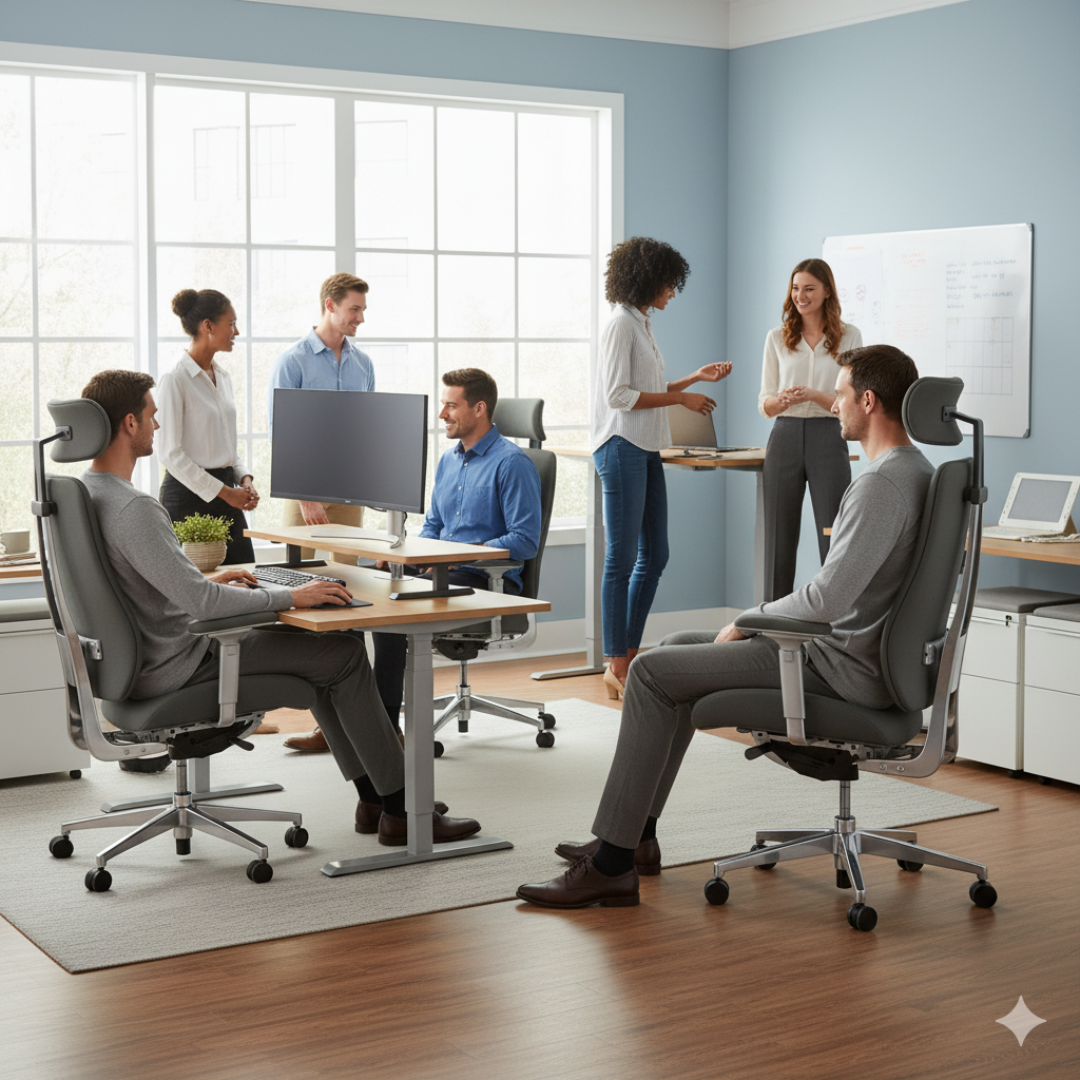
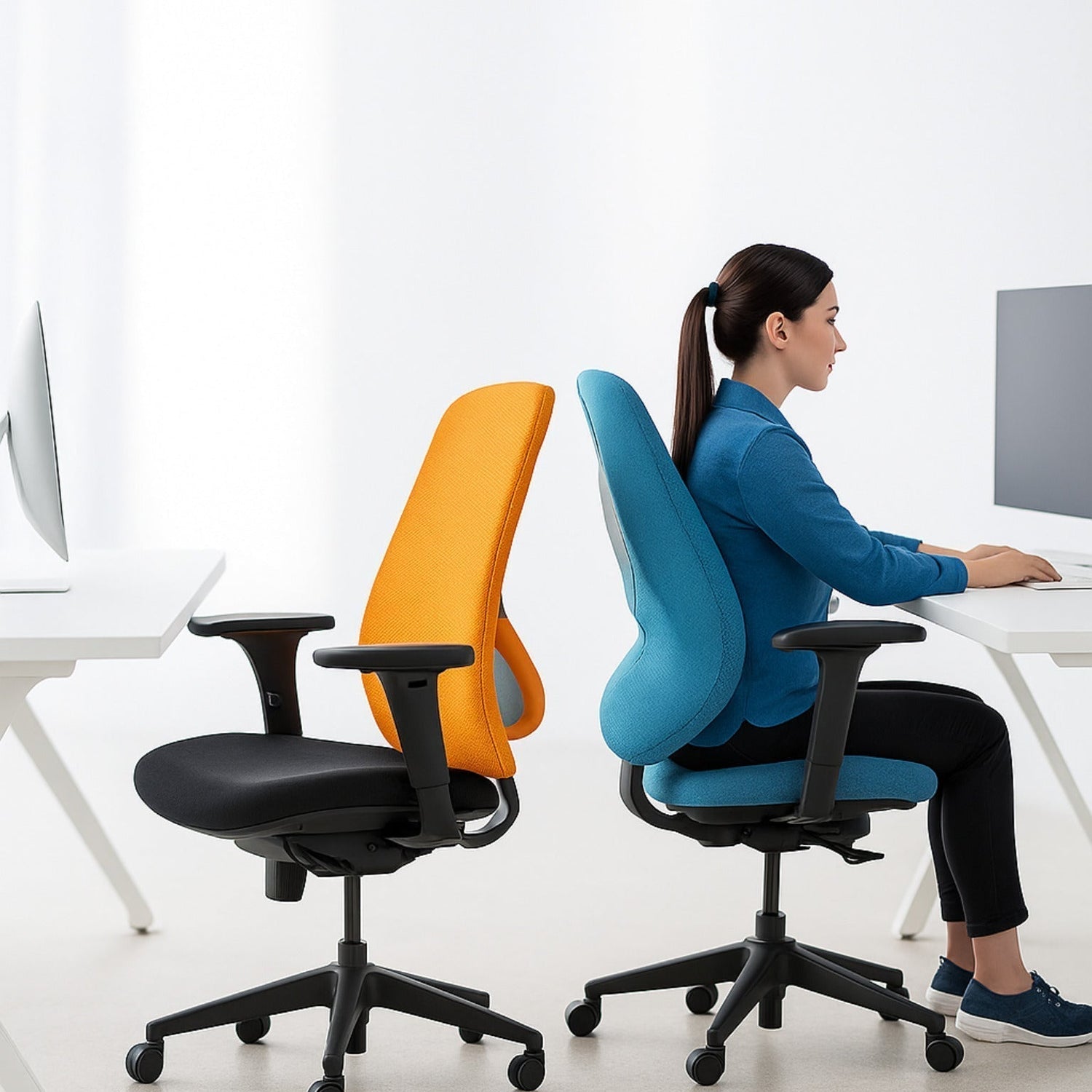
A home office chair has to work with the desk and room you actually have. A model that fits well in a showroom can become less useful if its arms stop short of the keyboard or its base crowds the space.
The strongest choice combines personal fit with practical room requirements: working height, usable seat depth, desk access, floor compatibility, and the way you like to move.
The desk may be the first constraint
A dining table or fixed desk can sit too high for a comfortable keyboard position. Lowering the chair to support the feet may leave the work farther above the elbows. Raising the chair can improve access, but the feet may then need stable support.
A suitable keyboard tray, a different work surface, or a footrest can address a relationship the chair alone cannot solve. Space beneath the desk also needs to allow the knees and chair to move comfortably.
The arms deserve the same attention. A large pad can be comfortable away from the desk but prevent close access during typing.
Seat fit is more useful than a body-type label
Height is useful context, but thigh length, lower-leg length, torso length, and usable width determine more of the fit. The seat should let you use the backrest while leaving room behind the knees.
A lower cylinder addresses seat height. A shorter-depth platform addresses thigh length. A tall back provides a different contact area. These features solve separate problems.
Comparing the chair you use now can help identify the relevant change. “Too deep at the shortest setting” is a useful requirement for the next model.
A laptop setup can limit any chair
A laptop joins the screen and keyboard in one device. Raising the screen may leave the keyboard too high; placing the keyboard comfortably may leave the screen low.
For sustained desk work, a separate keyboard and mouse can allow the screen and input devices to be positioned independently. The primary display should be readable without repeatedly leaning away from the backrest.
The wider setup is described in our office-ergonomics guide. A chair is part of that arrangement rather than a substitute for it.
Choose movement that suits your day
Independent controls allow several angles to be positioned separately. Synchronous recline links seat and back movement. Body-weight-responsive mechanisms provide a different feel with less conventional tension setting.
Forward tilt is not automatically essential for typing. The seat position, desk reach, and control range need to feel useful together. A tilt that makes you slide or brace is not a good default.
A home-workday label also does not establish intensive-use requirements. The expected workload and complete configuration determine whether a specialized model is needed.
Three current OMC options to compare
PAC55-7a: the current PA55 counterpart

The PAC55-7a is the current task-chair comparison replacing the older PA55 reference. It offers seat-depth and back-height adjustment with independent positioning controls.
Its dimensions and selected arms should be compared with the desk and user. The current naming makes the correct product easier to identify.
PT72IU: for a confirmed intensive-use requirement

The PT72IU, formerly IU72, belongs to the intensive-use task-chair family. It offers a seat slider, back-height adjustment, and independent seat and back positioning.
The PT72IU is a task chair. A task stool serves an elevated work surface and needs a different height comparison from seating at a conventional home desk.
OM5 Evolved: a responsive recline alternative

The current OM5 Evolved combines Body Activated Motion with lumbar and seat-depth adjustment. It is a useful comparison when you prefer a self-weighing recline instead of conventional manual resistance setting.
It does not automatically reshape every dimension to the body. Working height, depth, lumbar positioning, and arms still matter.
Materials, floor type, and available space
A mesh back, padded back, or flexible polymer design can create a different contact feel and appearance. The exact upholstery also determines cleaning requirements; material grade alone is not a durability score.
Floor compatibility belongs in the caster choice. Suitable soft-tread wheels may be preferable for some hard floors, but clean wheel treads and floor condition matter too. No caster can promise that every floor remains unmarked.
Base diameter, arm span, and the space needed to turn are useful measurements in a small room. A visually compact back does not necessarily mean a smaller floor footprint.
A chair that can share the room
If another person uses the desk, a useful adjustment range becomes more valuable. Clear controls make it easier to restore each person's preferred position.
Substantially different seat requirements may call for different chairs rather than a single model stretched to both extremes. A shared screen and work surface also need a usable range.
Choosing around a specific improvement
A useful purchase has a clear purpose: shorter depth, more usable width, better desk access, or a recline style you prefer. Current configured prices and options are available on the linked product pages.
OMC can help compare the current chair, desk height, available space, and preferred support. That makes the recommendation practical for the home you work in.