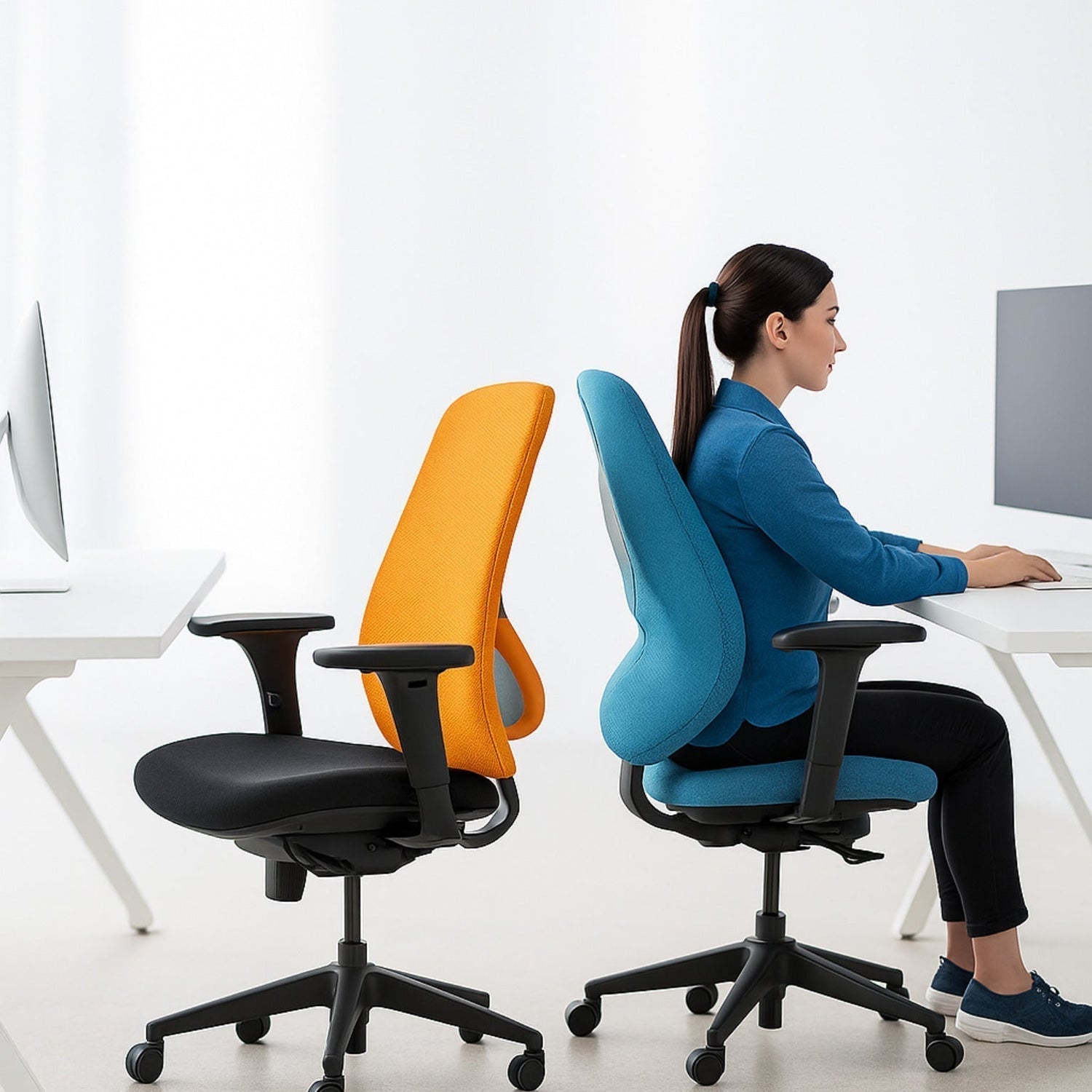
The Office Master PT78 is an upholstered high-back task chair for people who want several ways to position the seat and back. Its wider seat, adjustable lumbar support, and standard full multi-function mechanism make it a useful comparison for everyday desk work.
The value is in how those adjustments fit your body and work. A high back is not a shortcut to comfort, and a more complicated mechanism is worthwhile only when you use the extra control.

Current standard PT78 specifications
| Feature | Standard specification |
|---|---|
| Seat width | 21 inches |
| Seat depth | Approximately 18–21.1 inches |
| Seat height | Approximately 17–22 inches |
| Backrest | Approximately 19.5 inches wide by 22 inches high |
| Back-height travel | 4 inches |
| Standard mechanism | Full multi-function -8a |
| Listed standard weight capacity | 300 lb |
These figures reflect the current standard model. Available alternate mechanisms, cylinders, arms, and other components can change a configured chair's functions or fit. Capacity and usage requirements should match the complete configuration.
Lumbar support that you can position
The PT78 has adjustable lumbar support, allowing the lower-back contour to become more or less pronounced. Back-height adjustment also helps position that contour vertically.
Those two changes do different jobs. A comfortable amount of protrusion can still feel wrong if it contacts too high or too low. More pronounced support is not automatically better; the useful setting lets you rest against the back without feeling pushed away from it.
Seat depth for a wider range of leg lengths
The seat slider moves the seat relative to the backrest. Within the PT78's range, you can leave clearance behind the knees while retaining thigh support and contact with the back.
The 21-inch width gives more lateral room than some narrower PT models. It does not make the chair suitable for every larger body, and it does not increase the listed load rating. Arm spacing and the usable space between the arms are separate measurements.
For a user whose thighs are shorter, the shortest PT78 setting may still feel too deep. That is a fit issue rather than a reason to sit forward and leave the back unused.
Back-height adjustment: the current range
The current PT78 specification lists four inches of back-height travel. Earlier wording in this article referred to three inches. That adjustment moves the backrest; it does not change seat height or turn the back into a headrest.
A tall back can provide welcome contact behind more of the torso. The right position is still personal, especially around the upper edge and shoulders.
Rocking, resistance, and separate angles
The standard -8a mechanism provides rocking motion and adjustable resistance, along with separate seat and back positioning. This gives the user more control than a basic height-only task chair.
Rocking resistance determines how easily the mechanism yields when you lean back. It is useful when the chair moves smoothly with you rather than feeling difficult to recline or unexpectedly loose.
The correct knob direction and lever operation belong to the instructions for your actual mechanism. PT78 listings can offer alternate controls; assuming the same operating sequence for all of them can lead to a poor setup. Releasing a recline control is best done with the back supported and the movement anticipated.
When the PT78 belongs on your shortlist
Consider the PT78 when you like upholstered support, its seat dimensions fit, and you want to set several aspects of the chair independently. It may suit someone who has found a simpler mechanism too limiting.
A smaller user may prefer the PT62, which has a narrower seat, a shorter depth range, and a lower standard seat-height range. For a substantially taller back in the same wider-seat family, the PT79 is another comparison. Those alternatives address different measurements, rather than representing a fixed ranking.
Options can matter as much as the base model
Arms need to support the forearms without raising the shoulders or blocking desk access. Upholstery changes the feel and appearance, while casters and cylinder choices affect floor compatibility and height. The product photograph may show options that differ from the final selection.
OMC can help compare the standard PT78 with a requested configuration. That is especially useful when choosing alternate controls, a different cylinder, or a fabric with particular cleaning requirements.
The PT78's main tradeoff
The PT78 offers useful adjustment and a generously sized upholstered seat. In return, there are more controls to learn and more dimensions to compare than on a simple chair. For a user who needs those adjustments and fits the seat, that is a worthwhile tradeoff.
The current PT78 product page contains available choices and current pricing. The chair can support a comfortable workstation, but movement and the placement of the desk equipment still matter through the day.