The easiest way to narrow the Office Master range is to separate three questions: does the chair fit, do you like the way it moves, and does its configuration suit the job? Those answers are more useful than a long list of features or a claim that one model works for everyone.
OM Seating offers upholstered, mesh, and flexible polymer designs, from straightforward task chairs to intensive-use seating. The differences become clearer when you connect each family to a practical requirement.
Begin with the limitation you want to change
Your current chair can provide a useful reference even if you dislike it. A seat that feels too deep suggests a shorter minimum depth. A back that stops below the area you want supported suggests a different back shape or height. A chair that will not move comfortably with you suggests a different mechanism.
Overall height does not describe the whole fit. Two people of the same height can have different leg and torso proportions. Seat height, usable depth, width between the arms, and back contact tell a more complete story.
For a shared workstation, the useful range matters as well. A chair that fits one person at the end of its adjustment range may not accommodate the next user.
Choose the movement style you prefer
Independent seat and back controls
A multi-function mechanism lets you position several parts of the chair separately. The YS72 is one example with independent seat and back angles. The standard PT78 adds a full multi-function approach with rocking and resistance adjustment.
This style suits people who like precise positioning and are comfortable learning several controls. Its flexibility is useful when the controls solve a real preference, rather than simply making the specification sheet longer.
Coordinated recline
A synchronous mechanism links seat and back movement. The YS78 combines that approach with a high mesh back, seat slider, and three-stage locking tilt.
A linked recline can feel more straightforward than setting each angle separately. Available locking positions and resistance adjustment still differ among models.
Body-weight-responsive movement
The current OM5 Evolved family uses Body Activated Motion and a self-weighing recline. It reduces the need for conventional manual tension adjustment while retaining useful fit controls, including seat-depth and lumbar adjustment.

It is a different movement style, not a promise of automatic fit. The OM5 Active Tasker is also a separate design with a different feature set.
Materials change the feel
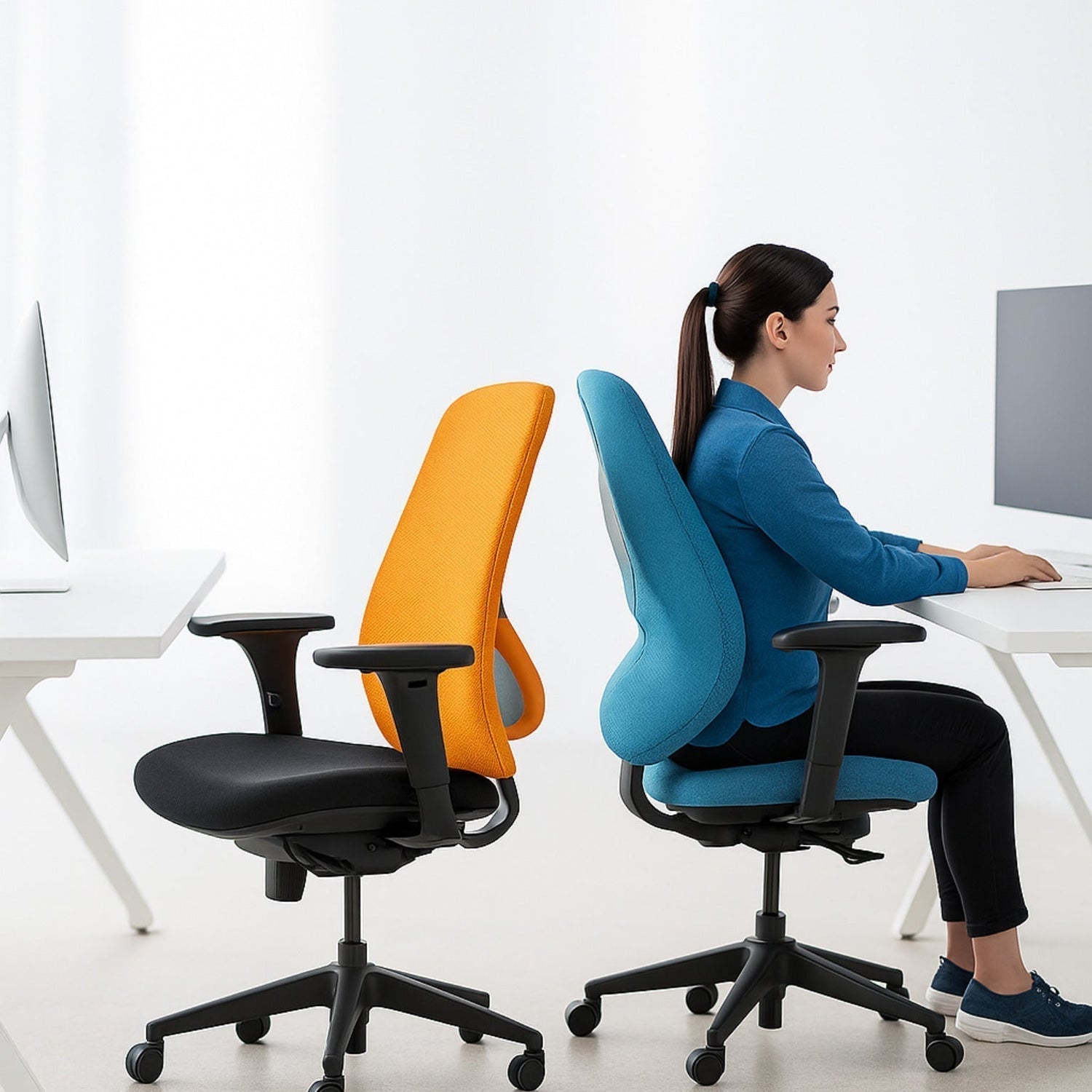
An upholstered back provides a padded contact surface. Mesh feels different and allows air movement through the backrest. A flexible polymer back has its own shape and response. A preference for one material is a reasonable way to narrow the range after confirming dimensions.
Seat upholstery is a separate choice from the back construction. A mesh-back chair often still has an upholstered seat. Fabric grade commonly affects price and available materials; a higher number is not a universal guarantee of longer life.
For cleaning-intensive workplaces, compatibility with the actual cleaning products matters. The textile manufacturer's instructions are a better reference than a general claim that vinyl or leather is easy to disinfect.
Current families worth comparing
- PT Paramount: upholstered task seating with different seat and back sizes, including the smaller PT62 and wider PT78.
- Yes: mesh-back seating with several mechanisms; YS72 and YS78 take different approaches to adjustment.
- PAC: task-chair and stool options, with current PAC names replacing older PA and PC references.
- OM5 Evolved: body-weight-responsive movement with current polymer-back and mesh-back options.
- Truly: configurable back support and several mechanism styles, including the TY68b8 full multi-function model.
- Intensive-use and heavy-duty families: specific configurations for demanding workloads and higher load requirements.
The family name helps organize a comparison. The exact model and selected components settle the dimensions, functions, and rating.
The workstation can change the choice
A standard desk, a counter, and a laboratory bench need different seat-height ranges. A stool with a footring may suit an elevated surface; it is not automatically suitable for an ordinary desk.
Armrests also need room beneath or beside the work surface. If they prevent close access, you may end up reaching even in a chair whose seat fits well. Floor type, caster choice, and the intended workload belong in the same comparison.
A budget built around useful features
The most worthwhile upgrade is often quite specific: a seat slider, a lower cylinder, a more suitable arm range, or a mechanism you prefer. An expensive finish cannot compensate for the wrong seat size.
The configured price can differ from the starting price once upholstery and options are selected. Comparing complete configurations is more useful than comparing only the base model names.
Getting from a long list to a shortlist
The OMC Chair Finder page is one place to begin exploring the range. Recommendations are a starting point; measurements and the exact configuration still matter.
OMC can also help compare a few models around the chair you currently use, the dimensions you need to change, and your preferred movement style. That makes the conversation about a chair that fits your work, rather than a universal “best” model.